
Pedagogy and staff
The programme is a two-year master’s degree focused on enabling sustainable transformation in industry. It is designed to gradually build your competence – from understanding complex sustainability challenges to developing concrete and innovative solutions together with companies and other actors, while leading the change processes needed for successful transitions to sustainability.
The image below shows you how the different courses come together to form blocks in different areas, such as sustainable product innovation (dark blue), strategic organizational development (light blue) and leadership in socio-technical systems (in orange). Here you can find more information on each of the courses.


However, we strongly believe that the programme is as much about the content as it is about the pedagogy and the people you meet. We think about the programme as an ecosystem of components that make up the learning environment.
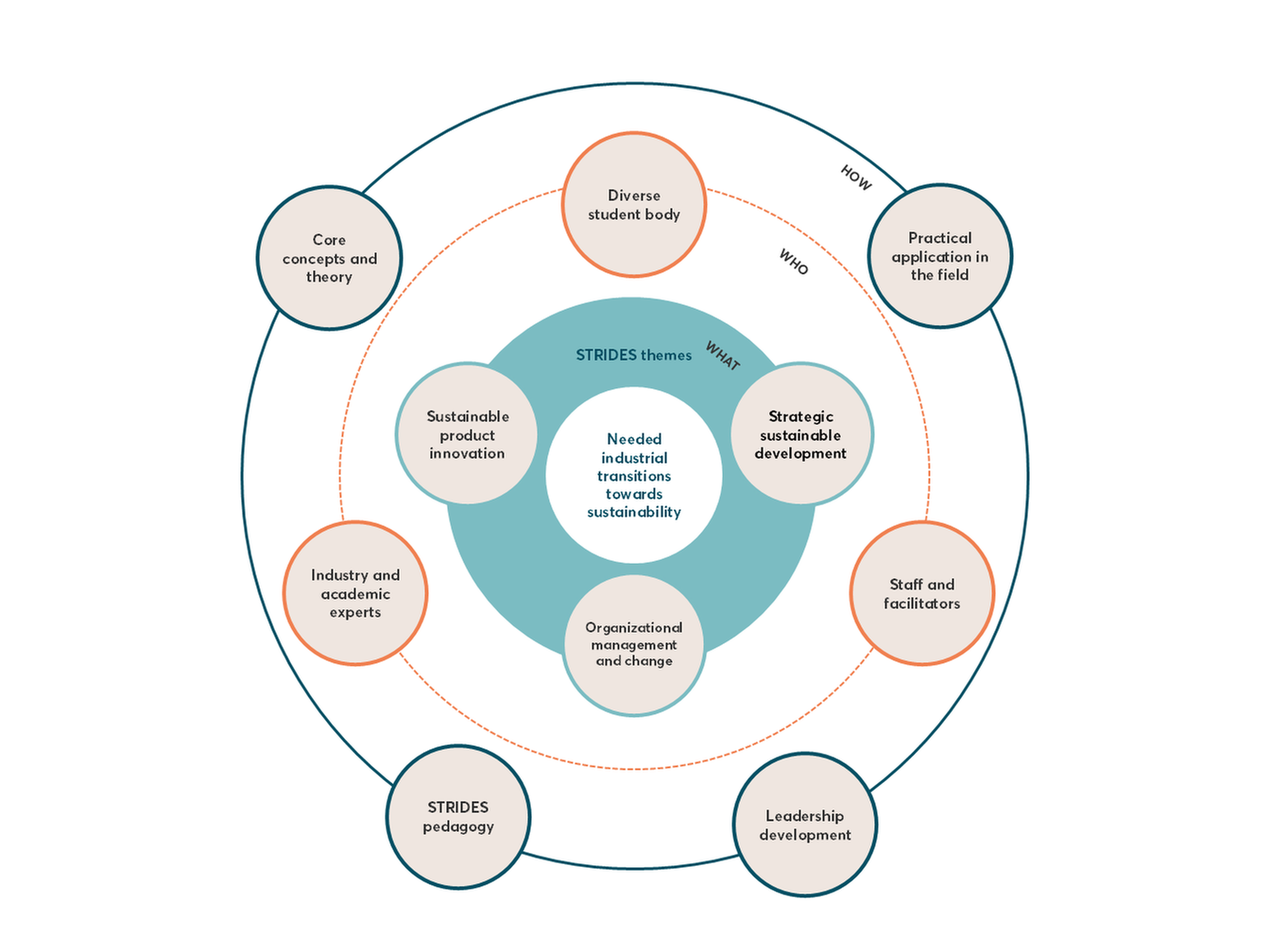
Below we introduce how we think about learning and as well as our staff.
Pedagogy

Experiential learning in fast learning loops
For us, learning by doing and reflecting on that experience is a key part of our pedagogy. We believe that real-world experiences and applications allow for better learning in real context and are more motivating and engaging for the students. We thus balance grounding in science with practical, hands-on work, emphasizing project work and close collaboration with industry, for example, through an internship. We also focus on innovation competencies and believe in a prototyping mindset, to try and get feedback quickly and learn faster, which is why this kind of approach is embedded in all of our projects.
Competence development, not knowledge download
These days anyone can look up any content-related information in seconds. However, what we do with this information, how we evaluate it and make sense of, that is a competence to train. In addition, there are many competencies in the inter and intra-personal realm that are of importance for sustainability transitions We thus ground all our education in competence and capacity development and do not believe in knowledge memorization.
Social learning: diversity and dialogue
We believe that we learn best with and through each other because that is how humans construct meaning. Two powerful mechanisms for social learning are diversity in the classroom and utilizing dialogue methods; the combination of diverse experiences and voices in the room brought together in generative dialogue is a powerful ground for learning, especially transformational learning.
Self-directed Learning
Coming to us for an advanced degree, we believe that as an adult your learning can only be self-directed. This means that while we create the learning experience, the ultimate responsibility for your learning lies with you. It also means that we have created a learning environment, where each of you can have the opportunity to explore your passions and interest in various topics and thus create a learning journey truly meaningful for you. And we are here to support you and coach and guide you every step of the way!
A co-creative process
Inviting adults into their own self-directed learning process focused on competence development and facilitating this in a collective setting, learning becomes a co-created process. You will actively shape your education, rather than passively consume it and together we will form a professional learning community made up of students, learning facilitators, researchers, global experts and practitioners from the field.
Life-long learning journey
We consider all humans natural life-long learners and we work with this intentionally. We are conscious that the programme is one step of your larger learning journey (and development journey as a whole human being) and we aim to build on your previous knowledge and experience and to further instill in you life-long learning skills.
Staff
Dr. Göran Broman is Professor and Head of the Department of Strategic Sustainable Development at BTH. He holds a PhD in Mechanical Engineering from Lund University. He has also studied subjects such as Human Ecology, Economics, Resource Theory and Leadership, and has led the establishment of Strategic Sustainable Development as a new transdisciplinary academic subject area. He has also worked in industry with innovation and quality assurance and he advises and trains leaders and change agents in industry and society in leadership and innovation for sustainability.
Dr. Patricia Lagun Mesquita is a senior lecturer at the Department of Strategic Sustainable Development and the manager of the Masters Program in Strategic Innovation and Design for Sustainability. Her research focuses on social sustainability in product and organization development. Since 2013 she has been teaching various courses at BTH, such as strategic sustainable development, strategic planning for sustainability, social sustainability in product and service development, and sustainable product development. Patricia has prior experience in sustainability consulting for the mining, oil and gas industries.
Dr. Jesko Schulte is a senior lecturer at the Department of Strategic Sustainable Development at BTH. He holds B.Sc. and M.Sc. degrees in environmental science from Linnaeus University, Kalmar, Sweden. Characterized by close collaboration with industry, his research focuses on how a strategic sustainable development perspective can be integrated and implemented in the early phases of the product development process. Among other things, he does research on sustainability assessments and sustainability risk management to connect socio-ecological sustainability aspects to business implications.
Dr. Matilda Watz is a Senior Lecturer at the Department of Strategic Sustainable Development. Her research and teaching focus is Sustainable Product Development, especially practices and decision-making considering requirements development and management, and its interfaces with innovation, business strategy and risk management. This involves understanding and developing new processes, methods, tools and routines for identification, modelling and selection of sustainability criteria and design requirements to guide concept selection and trade-off management for sustainable product development in different types of product development companies. Matilda holds a PhD in Strategic Sustainable Development from BTH, a M.Sc. in Sustainable Technology, and a B.Sc. in Mechanical Engineering from the Royal Institute of Technology, Sweden.
Josefin Lövdahl is a University Lecturer at the Department of Strategic Sustainable Development. She holds a Degree of Licentiate in Strategic Sustainable Development from BTH, and M.Sc in Chemical Engineering with a specialization in Sustainable Energy Systems from Chalmers University of Technology, Sweden. Her research has focused on clarifying how to integrate a strategic sustainable development perspective in product sustainability performance assessment practices. Her teaching focus is Sustainable Product Development.
Cecilia Braga is a doctoral candidate at the Department of Strategic Sustainable Development at Blekinge Institute of Technology (BTH). She holds a M.Sc. in Strategic Leadership Towards Sustainability from BTH and a bachelor in International Relations from the Pontifícia Universidade Católica de Minas Gerais (Brazil). She has ten years of experience in corporate sustainability strategy and reporting. Currently, her research focuses on product sustainability performance assessment and strategic decision-making.
Jennifer Woofter is a doctoral candidate at the Department of Strategic Sustainable Development at Blekinge Institute of Technology (BTH) in Karlskrona, Sweden. She has more than two decades of experience in corporate sustainability strategy and implementation and has worked with more than 300 organizations to navigate sustainability risks and opportunities. Her research currently focuses on the intersection of business intelligence and big data analytics, sustainability risk management, and strategic decision-making. Jennifer holds an M.Sc. in Strategic Leadership Towards Sustainability from BTH, an M.A. in Political Science from Virginia Polytechnic Institute and State University, and a B.S. from the University of Oregon.
Dr. Merlina Missimer is the Co-Director of the MSLS programme. She is also the Deputy Head of Department a the Department of Strategic Sustainable Development and a researcher in Straategic Leadership Towards Sustainability at Blekinge Institute of Technology. Her research has a focus on the social dimensions of sustainability as well as Education for Sustainability Leadership. She holds a B.Sc. in international environmental studies from Franklin & Marshall College, USA, and a Masters in Strategic Leadership towards Sustainability from BTH.
Dr. Henrik Ny is an associate professor in Strategic Sustainable Development at BTH, where he leads the SustainTrans Team, focusing on accelerated transitions to sustainable transport and energy systems (see www.bth.se/sustaintrans). Earlier in his career, he worked with environmental management in industry at Perstorp AB. In parallel, he is the initiator of Swedish Roadmapper Laboratory, where research and modelling tools for sustainability transitions are developed and shared, and he carries out consulting assignments through Swedish Roadmapper Consulting AB (see roadmapper.se). He holds a Ph.D from BTH and two master’s degrees from Lund University in Chemical Engineering and Environmental Management and Policy.
Dr. Cecilia Bratt is a senior lecturer at the Department of Strategic Sustainable Development at BTH. She has a Master of Science degree in Chemical Engineering from Chalmers Technical University. She has also one year of studies in pedagogy for upper secondary school teachers at Linköping University. She holds a Ph.D from BTH in Strategic Sustainable Development, with a focus on how to integrate a strategic sustainability perspective into supply chain management, procurement and eco-labelling policies. She has since 2012 been responsible for the basic sustainability course given to engineering students at BTH. She is currently the director of studies at the Department of Strategic Sustainable Development at BTH.
Dr. Sven Borén is a senior lecturer at the Department of Strategic Sustainable Development at BTH. Sven is a mechanical engineer with more than 15 years’ experience from a naval shipyard regarding management, engineering, and design. He earned a MSc degree in 2010 within strategic leadership towards sustainability, and a PhD degree in 2018 at BTH with a focus on how electric vehicles can contribute to a strategic sustainable development. Sven also had the opportunity to be TISU’s head of department during 2020-2024. The current focus of the research is to find models, methods and tools for shipping to accelerate the transition towards full sustainability. In teaching, Sven leads courses about sustainable energy systems and basic sustainability and have lead courses about Project Management and Energy systems within the Energy Systems for Sustainable Development program at BTH.
Dr. Rachael Gould´s aim is to help companies integrate sustainability considerations into their design work, whether developing a digital game or a physical product. She is also passionate about helping students and practitioners learn to work towards sustainability in their design context. Rachael works with the following questions:
- How can digital games promote sustainability action while also reducing their own negative sustainability impacts?
- How can we achieve both digitalisation in the service of sustainability and sustainable design of digital systems?
- How do you incorporate sustainability into design decisions and still make good decisions?
- How can you support people to change their behaviour to become more sustainable?
Rachael has a PhD in strategic sustainable development, focused on behaviour change for sustainability and decision-making when integrating sustainability in design processes. She also has master’s degrees in strategic leadership for sustainability and in mathematics and physics.
Dr. Lisa Wälitalo is a postdoctoral researcher at the Department of Strategic Sustainable Development with a focus on municipal and regional development. Building from several years of action research with more than ten municipalities and regions, her current work aims to support long-term capacity-building for sustainability integration among local and regional actors - both within their specific operations and in collaboration with others - to accelerate the necessary transition. Her work helps bridge the gap between academia and practice, promoting a sustainable future. Lisa holds a PhD in Strategic Sustainable Development from BTH and a M.Sc. in Environmental Health from Umeå University.
Dr. Carolina Villamil is a University Lecturer at the Department of Strategic Sustainable Development. She holds a PhD in Strategic Sustainable Development from BTH, a M.Sc. in Sustainable Product Service System Innovation from BTH and a BA in Industrial Design from Universidad Nacional de Colombia. Her research and teaching are related to product design and gamification linked with strategic sustainable development. She has been a teacher since 2006 in Colombia and Sweden.
Dr. James Ayers is an educator and researcher working at the intersection of education, complexity and leadership in the context of strategic sustainable development. His research considers the design and implementation of learning environments for sustainability with a focus on transformational learning and the development of complexity literacy within students. He has a Masters in Strategic Leadership towards Sustainability, a Graduate Diploma of Journalism and a Bachelor of Creative Arts. Prior to his career in academia, he specialized in sustainability communications for large organizations in Australia and was the Communications Manager for Engineers Without Borders Australia.
M.Sc. Pierre Johnson is a lecturer at the Department of Strategic Sustainable Development at BTH. He has a B.Sc. in electrical engineering from Carleton University, Canada, and a Master’s in Strategic Leadership towards Sustainability from BTH. In between the bachelor and master’s degrees, he was a software developer and manager in telecommunications, worked as an independent consultant and facilitator, which in combination with community activism on sustainability led to work in municipal affairs.
Elaine Daly is a University Lecturer at the Department of Strategic Sustainable Development at BTH for more than 10 years. She holds a Degree of Licentiate in Strategic Sustainable Development from BTH and is a PhD candidate with a focus on employee agency within corporate sustainability transformations. Prior to her work in academia, she had a background in mechanical engineering, finance and international development. In addition, Elaine is course responsible for the Strategic Sustainable Development course which forms the backbone of our in person Masters programme and teaches both online and on‑campus Bachelor’s and Master’s courses focusing on strategic sustainable development and leadership in complexity.
Dana Bergman is a University Lecturer at the Department of Strategic Sustainable Development at BTH. She is a learning facilitator in the MSLS programme and also coordinates its communications and admissions efforts. In addition, Dana is course responsible for the online course Foundations for Strategic Sustainable Development and teaches both online and on‑campus Bachelor’s and Master’s courses focusing on strategic sustainable development in Swedish and English. Dana holds a BA in Social and Cultural Studies from the European University Viadrina Frankfurt (Oder), Germany, and a Master’s degree in Strategic Leadership towards Sustainability from BTH.
Marta Boström Wycichowska is the department coordinator, working behind the scenes, assisting the staff and teachers. In addition to her administrative role, she also teaches behaviour change for sustainability. She holds a B.Sc. in Social Psychology from Uppsala University, Sweden.